Showing posts with label The Past. Show all posts

Sunday, March 24, 2013

Baskets From The Kingdom Of Lesotho

And in between something from my archive of "Africa's Past".

 
This old image dates back to the 1950's and is entitled" Basutos storing grain".

Basutoland or officially the Territory of Basutoland, was a British Crown colony established in 1884 after the Cape Colony's inability to control the territory. It was divided into seven administrative districts; Berea, Leribe, Maseru, Mohales Hoek, Mafeteng, Qacha's Nek and Quthing.
Basutoland was renamed the Kingdom of Lesotho upon independence from the United Kingdom on October 4, 1966.

Tuesday, January 8, 2013

Once Upon A Time At The Cango Caves

Originating From The Chocolat Negro Archive
Once Upon A Time In South Africa At The Cango Caves - The Entrance To The Cango Caves  in the 1950's

Today we are posting two lovely old prints of the famous Cango Caves in South Africa, dating back to the 1950's, a time when art lovers would sit in front of their easels painting the scenery outside the caves, the ladies wearing elegant dresses and summer hats. 

Prof. A.J.H. Goodwin  a archeologist of the University of Cape Town carried out a test excavation in the Cango Caves in 1930. Stone artefacts and other cultural material show people had been living in the entrance to the caves over a long period during the Middle and Later Stone Ages.
The caves were discovered in 1780 by a local farmer named Jacobus Van Zyl. The chamber he first was lowered down into (Van Zyl Hall, which is as long as a football field), is named in his honor. Further exploration was done and a second chamber discovered in 1792. The caves soon became a popular place to visit.

Colored Light floods the walls of the famous caves
The Cango Caves In the 1950s - The Throne Room In the Cango Caves approximately 60 years ago
There goes the legend that Mr. Johnny van Wassenaer, the cave’s first official guide had walked 29 hours to find the end of the caves in 1898. When there, he is said to have calculated that he was 25 km from the entrance, and 275m under ground. His route apparently followed an underground river. So far, no caves have been found to support this story.

The Cango Caves are located in Precambrian limestones at the foothills of the Swartberg range near the town of Oudtshoorn in the Western Cape Province of South Africa. The principal cave is one of the country's finest, best known and most popular tourist caves and attracts many visitors from overseas. Although the extensive system of tunnels and chambers go on for over four kilometers, only about a quarter of this is open to visitors, who may proceed into the cave only in groups supervised by a guide. Tours are conducted at regular intervals on most days - there is a "Standard Tour" which takes an hour and an "Adventure Tour" which takes an hour and a half. The "Adventure Tour" consists of crawling through narrow passages and climbing up steep rock formations guided by small lights. The caves contain spectacular halls and grand limestone formations (on both tours) as well as some rather small passages on the Adventure Tour. The smallest passage that tourists will have to pass through on the Adventure Tour is just under 30cm high at the exit.
The caves are considered to be part of the Garden Route.

Sunday, September 30, 2012

Somebody Else's Happiness


Is it not beautiful ?
It is so very beautiful!
They are so beautiful in their happiness
Often I ask myself
What has happened?
That the reminders of the most beautiful moments of somebody else's life
And the memories of somebody else's happiness
Have landed in a junk shop.

I ask myself with a little bit of fear in my heart
Will the decisive moments of my own life
Captured in photographs
Also be thrown away some day?
Because I do not matter so much anymore
To anyone.

But then again, we really are not that important
Looking at it from a larger perspective. 


Photograph of an unknown couple found in a junk shop in East London.
Entitled by me " Somebody Else's Happiness"

Saturday, August 4, 2012

Crossing Waters In Zimbabwe in 1978 (then Rhodesia)


This image comes from my archive of vintage Africa pictures.
Entitled: September At Mare Dam, in the foothills of the Inyangombe Mountains
Zimbabwe, then Rhodesia in 1978

Friday, December 9, 2011

A Small Time Capsule Of The Wankie National Park 1959

Time Capsule Rhodesia 1959 - A Pictorial Tour Of A Beautiful Country

Africa's Past
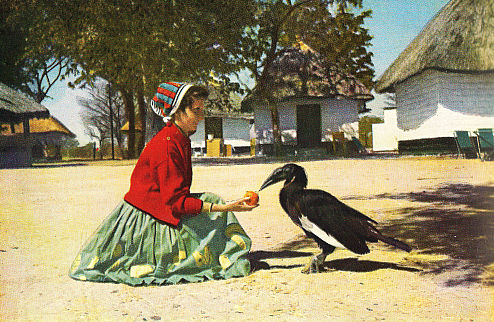
Main Camp in the Wankie Game Reserve. This is a pet ground hornbill, much pampered by all visitors

About my love for old pictures and photographs, you know. My fascination of finding a timeline between a place, eternalised on pictures years ago and the reality of the same place today, I am sharing with you now.

In the beginning when I started this blog my vision was to create a time capsule for me and the ones I share and have shared my life with.  There was a moment when I realized I have lived so much already, have been given so much, received so much, experienced so much that I could fill ten adventure story books for boys and girls. This is a blessing of the highest kind. 
But to my great disgust and even greater fear I had to accept the fact that some memories were starting to fade, becoming not so clear anymore. The past is taken over by the future at a rapid pace. 
And life is still exciting ! Another great blessing. But what of all this would I like to remember ? And what would I like the others that come after me to remember ?
I want to remember pretty accurately everything I had in my life. 

Soon I realized others have been doing it all the time inconsciously. Small time capsules are everwhere, still vibrating with energy in some hidden places, waiting to be found just to be sent on a journey of spreading wisdom again. I see them everywhere, small time capsules created by writers, painters, publishing houses and individuals who have left their memories in written or pictorial form behind for the world to see. They are waiting to be released so that they can time travel again. The whole universe consists of traveling time capsules.


One of the few places where men and animals are friends Wankie Game Reserve 1959

So today I am sending a small African time capsule from 1959 in your direction. May it float across the vast cyber universe forever. May somebody find a liking to it. The time capsule has left a beautiful place named Zimbabwe, then called Rhodesia, many decades ago. What it had to say at the time was of greatest accuracy and importance. It is not anymore.

South of the Victoria Falls the road leads to the Wankie Game Reserve, fast becoming recognized as the best game reserve in Southern Africa and, for density and variety of animal life, comparable even to the great game reserves of East Africa. Wankie takes it's name in corrputed fashion from the chief Wange, who ruled over this wild stretch of countryside before the white man came with modern ideas of game conservation. Scenically and geologically, it is a projection of the Kalahari, and there is talk of great a companion reserve being developed one day in Betchuana, across the boundary line which marks the western limit of the Wankie Game Reserve. Such a development would turn the twin reserves into the greatest single area in all Africa for game conservation. ( Pictures, Text by Howard Timmins Cape Town, 1959)

The Wankie Game Reserve is called the Hwange National Park today.


Wednesday, December 7, 2011

Old Lorenco Marques - The City Of Acacias


Then Called Polana Beach, Maputo, Mozambique


Something new and a little bit of old every day of your life. Seems like a good philosophy to me.

In this picture a view of Polana Beach in Maputo in the 1950's, also known as Lourenco Marques, capital of Mozambique.
Maputo is known as the City of Acacias in reference to the many acacia trees commonly found along its avenues. Another name given to it is the Pearl of the Indian Ocean. It was famous for the inscription "This is Portugal" on the walkway of its municipal building.


In this picture we see a partial view of Lourenco Marques commercial zone in the 1950's

Old Lourenco Marques - because it does really not look as sleepy as this anymore. Today it is a port city on the Indian ocean with its economy centered around the harbour and an estimated 9 % annual growth rate. 
Close to 1 800.000 million people live in Maputo. It is estimated that 80% of the city's population lives in slums without running water or electricity but the city has little money to invest in infrastructure.
Inequality in Maputo has grown considerably.


Tuesday, December 6, 2011

Swakopmund - Fishing From The Old Jetty


These old color prints show us what Swakopmund looked like in the 1950's before Angelina Jolie and Brad Pitt made this town famous by awaiting the birth to their child there in a seaside resort close by. Swakopmund was just a sleepy, very misty little village situated at the rough Atlantic coast of Namibia, then still called SWA - South West Africa. The old jetty was the place to be for fishing, and probably still is. At the time the wooden boards had holes and at a later stage it was even difficult to get to the end of the jetty.


A bird's eye view of the town with the vast Namib desert in the background. Then and now one of the most fascinating places in the world.
Today the town has changed completely. It has grown enormously and has become a tourist haven. I have spent many holidays there but I found it difficult to recognise the old streets.

Thursday, December 1, 2011

Capetonians On Picnic


This scene, eternalised on black and white film, dates back to 1965. I praise the unknown photographer.
It is entitled :
" On an early summer day in December, white South Africans picnic and converse in a grove of large fir trees in a Cape Town suburb."

Living proof that the culture of gathering around your cars, braaing, talking and drinking, equipped to the teeth with useful and unnecessary gadgets, has transcended all groups and races in South Africa. Not much different than Gugulethu or Bucaneers. Ok a little smaller ! And today the gentlemen don't wear ties to this occasion. But the hats remain part of the scenery.
If you do it, do it in style.

Tuesday, November 29, 2011

Some Things Remain Unchanged


These images were taken in the early 1970's, when Namibia was still called South West Africa. The Herero women in the photos are on their way to celebrate Herero Day in Okahandja wearing their distinct traditional dress.
The Herero came under the influence of German missionaries during the 19th century who took exception to what they considered to be the immodesty of the traditional Herero dress, or lack of dress. At the time the Victorian Dress was still considered to be appropriate for a woman and the missionaries wifes dressed the women of the Herero accordingly by sewing long dresses for them that covered the arms and the neck. The first dresses were sewn of a material called Blueprint, imported from Germnay.
But I must say I love African creativeness.  Just look at the girl in the back with the leather boots and the red mini skirt. No matter under what and whose influence Africans came over the years, there will always be uniqueness and freedom of interpretation in what they do.


Herero Women On A Farm

After a while the Herero women adopted the style of dress for which they are so famous today. The dress itself falls to the ankles and has long sleeves and a bodice that buttons up close to the neck. Over this, many women also wear a shawl. 
Under the dress the women wear seven petticoats to add fullness to the skirts. The uniquely shaped headpiece is said to resemble and pay homage to the horns of their cattle. Although  Namibia is a modern African country today, Herero women are still seen proudly wearing this elaborate costume in rural parts of the country as well as in the capital Windhoek capital. 

And by the way the cream colored handbag is the bomb and some vintage loving ladies would go crazy about it.  

Tuesday, November 22, 2011

Adderley Street In The Olden Days


Here is another nostalgic treat for the ones who have known Cape Town a couple of decades back.
Adderley Street decorated for the Holiday Season, meaning Christmas.

Cape Town In Summer


This beautiful scenary comes from my archive of old vintage prints and photographs that I have been collecting since years. The Mother-City with the famous table cloth on Table Mountain and a fair maiden admiring the view.  This print is available in bigger sizes as well. To check it out click here.

Thursday, November 10, 2011

Touring The SA In The Old Days


There was a time before the air-conditioned, four wheel drive luxury cars that roam all over the roads of SA today. Touring the SA in the old days must have been an alltogether different reality. I was not born then but  I am very much close to this reality now because I drive a 1968 VW beetle. There is not much use for a cockpit spray because the cockpit is so small and the bottle would last may be three years.
Here two lovely ladies are waving to the driver of an elegant and sexy SA tour bus thundering down the road to Oudtshoorn.


And here we have the "creme de la creme" - a SILVER EAGLE MOTORCOACH of the S.A. Railways parked in a romantice spot overlooking Pretoria.


In this picture the fire-red SA tour bus is roughing it a little bit out on a sand road close to Plettenberg Bay. In the far distance the Plettenberg hotel can be seen. These old prints have been in my archive for a while. They are memory postcards issued by S.A.Railways decades ago to show off the pride of their stable. They are undated and there are no names of photographers mentioned.


Friday, October 28, 2011

The Sani Pass

These charming old vintage prints, dating back to the 1960's, that have found their way just recently to my collection show an area in South-Africa that is of amazing beauty  The road that leads up to the Sani Pass.


The Wikipedia tells us the following:
The Sani Pass is located in the western end of Kwa Zulu province of South-Africa. It is a route that connects Kwazulu-Natal and Lesotho. It is a notoriously dangerous road, which requires the use of a 4x4 vehicle. This pass lies between the border controls of both countries and is approximately 9km in length and requires above average driving experience. It has occasional remains of vehicles that did not succeed in navigating its steep gradients and poor traction surfaces, and has a catalogue of frightening stories of failed attempts at ascending the path over the Northern Lesotho mountains. While South African immigration at the bottom of pass prohibits vehicles deemed unsuitable for the journey, the Lesotho border agents at the top generally allow vehicles of all types to attempt the descent. The Border tween the two Countries closes at 4:00 pm every day and the Pass is often closed due to weather conditions, especially during winter.


All the more interesting when looking at the vintage Landy in the first picture making his way up the steep mountain road. The second picture shows the Lesotho Border post the way it looked many decades ago. 

Friday, July 8, 2011

Pedestrians get Preference


In the Kruegerpark in South Africa in the 1950's. Hard to say what is more beautiful the lions or the cars ?

Friday, March 25, 2011

OUTSPAN


Outspan
Outspan is a word used in South African language and it is a partial translation from the Afrikaans " uitspan" which has been formed from the words uit (out) and spannen ( to stretch).  According to the dictionary it means:
1. an area on a farm kept available for travelers to rest and refresh animals
2. the act of unharnessing or unyoking
3.to unharness or unyoke (animals)


I have found these old photographs a while ago and they date back to the late 1800's and the beginning of the early 1900's and were taken in East London. They show not the actual OUTSPAN but a place where the ox-wagons that came to town, came to a halt, and were a market was.


Some of these ox-wagons had 12 oxen spanned in. Remember this was a time in Africa when automobiles had only appeared in very scarce numbers on the continent. Fresh vegetables grown on the farms and other products were sold in town. 
Although not of the best quality I find these pictures amazing.They show us a vague glimpse of a time when the first settlers had come to the Eastern Cape, when life was equal to hardship, and when cars and Landrovers did not exist to ease.
They show the lives of the ones who had left their continents in search of whatever it was to come and live somewhere else. 


Friday, March 11, 2011

THE COLORS OF MY NATION


In my last post I showed a vintage photo of a girl wearing traditional beaded jewelry from the KWA -ZULU NATAL region. 
In this post I would like to show you some of the styles and designs created in the Eastern Cape - the province where I live and work. Being a passionate collector of trade beads since many years I have always been fascinated by beaded jewelry and African beads.
These two photographs come also from my own collection. They show vintage mannequins that have been hand-crafted for a local museum display more than sixty years ago, attempting to portray the traditional Xhosa culture. 


Some of the most extensive collections of traditional beaded jewelry can be found in small museums in the Eastern Cape. I think that the importance of these collections, that were mostly collected privately at one stage, and have been donated to the museum later when the collectors have become old or died, will be understood and valued more at a later stage.
I have spent more than one afternoon looking at these incredibly beautiful and tasteful pieces from days of old.

You can see here that the designs of the beginning of the last century have been very elaborate and very complicated, making use of a lot of different colored beads. Classical traditional pieces are headbands, necklaces varying in length and width, belts, anklets as well as bracelets - some of them worn high above the elbow.


Interesting for me was, being just an observer and not an expert, that earrings are not to be seen often on old photographs. 
Today beaded jewelry has taken on a completely new and modern turn. And since huge dangles are the-in- thing of the moment we have worked on some funky designs. I collaborate with a mother-daughter-team who are experts in more than one beading technique, have taught me to bead and who bring my designs to life.


I have called this design " THE COLORS OF MY NATION " representing the spirit and the vibrancy of Africa.


The close up shows you the thin metal wire used to make these huge dangles more stable.
Beaded jewelry has always a 'soft  connotation" but for this design stability was needed. We have kept the traditional beading technique but added some modern material.


Stunning, is she not? Beautiful like a true African queen. Cornelia.


 And this design I call 'White African Wedding"
 Does one still need a dress when wearing them ?


And there is blue as well.


Black and White


and the urban look


You can check out more designs here: Chocolat Negro

Thursday, March 10, 2011

The Beauty Of Many


This is a vintage photograph from my collection called " THE ZULU MAIDEN ". It dates back to the late 1940's early 1950's and shows the magnificent traditional bead-work and jewelry created since hundreds of years in South-Africa. The adornments shown on this photograph originate from the Zulu tribe.  

Sunday, April 11, 2010

A SOUVENIR OF THE VICTORIA FALLS

These photos were taken decades ago at the Victoria Falls in then colonial Rhodesia.
 

The Main Fall in full flood


The Eastern End of the Victoria Falls.


A B.O.A.C Flying Boat on the mighty Zambezi.


Believe it or not : But this is a picture of the Royal Visit of Queen Elizabeth and her entourage at the falls.


The view of the Main Fall from the Rain Forest


And the View of the Victoria Falls bridge and the Second Gorge from the Victoria Falls Hotel know to travelers throughout the world. This old postcard is of a later date.

Thursday, April 8, 2010

Old Johannesburg

My last treasured find is a series of beautiful old photos of Johannesburg dating back to the 1960's.


Johannesburg Commissioner Street in the 1960's.


Jan Smuts International Airport 1960's.


A busy corner at the intersection of Eloff and Pritchard Street


Commissioner Street in the center of South-Africa's thriving commercial capital in the 1960's


The so called Impala Fountain ( Oppenheimer Memorial)


And a street scene in Hillbrow in the 1960's . It is said to be the most densely populated area in Southern Africa.


The Johannesburg Stock exchange, the financial heart of the city.
Related Posts with Thumbnails